

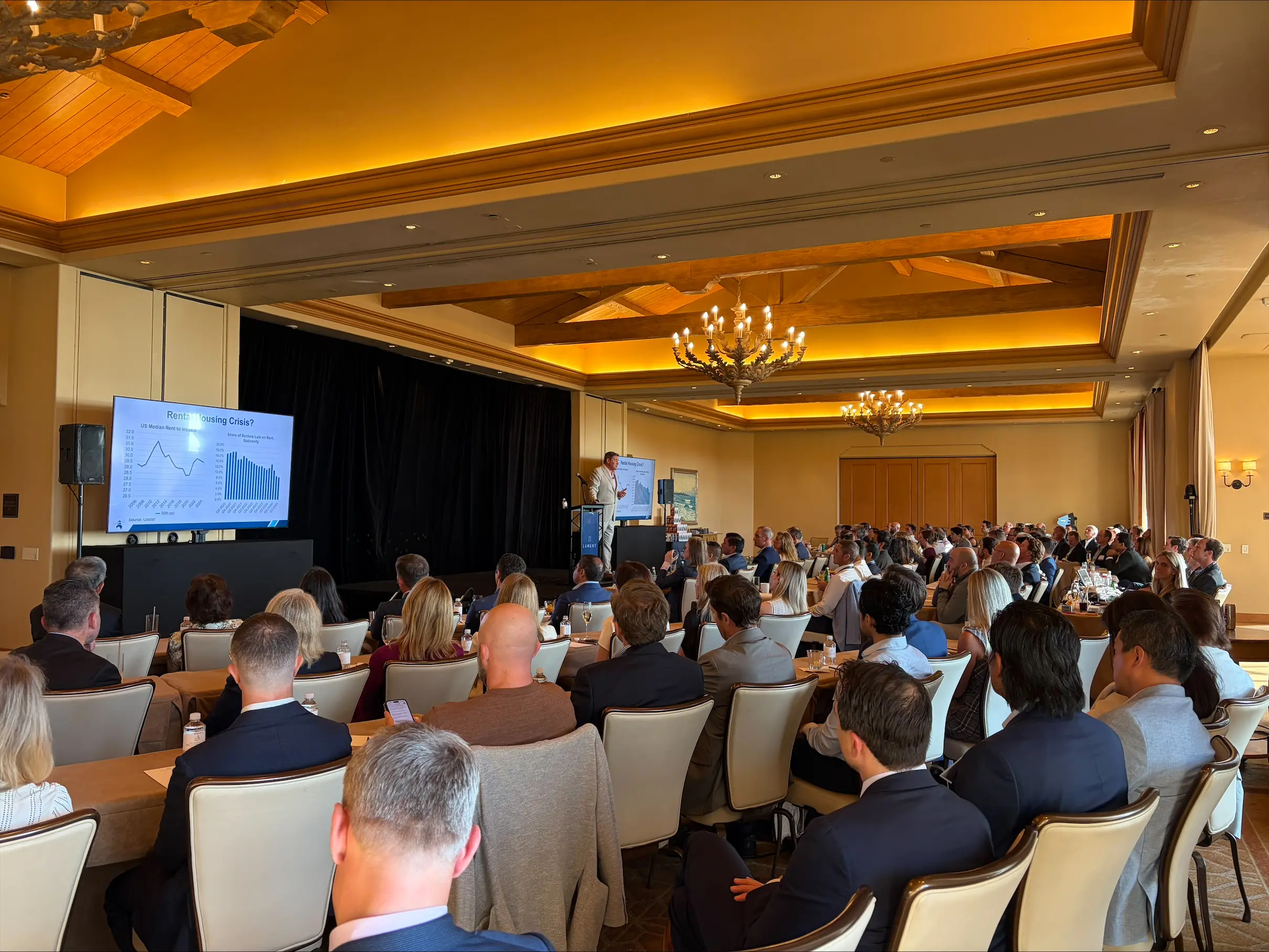
Economist Christopher Thornberg examined the forces driving interest rates higher and explained why disciplined multifamily investors may find opportunity on the other side of the market’s reset.
Multifamily investors have spent much of the past several years waiting for interest rates to fall. According to Beacon Economics founder Christopher Thornberg, Ph.D., that assumption may need to change.
Speaking at Lument’s The Exchange client event in Newport Beach, California, Thornberg argued that rates are likely to remain elevated, and potentially move higher, as demand for capital increasingly exceeds available supply. The event brought together leaders from Lument, the real estate investment community, and key industry partners for a timely discussion about the forces shaping multifamily investment.
“Rates are going to go up before they go down,” said Thornberg, founding partner of Beacon Economics and senior fellow at Pepperdine University. “A lot of investors have been anticipating that interest rates would come down. They’re not coming down, not in this market and not right now.”
For investors, the implication is clear: business plans should be evaluated against today’s borrowing costs rather than depend on the timing of a future decline in rates. Inflation and higher oil prices contributed to the recent rise, Thornberg said, but the underlying pressure is more fundamental. Heavy federal borrowing, capital-intensive artificial intelligence development, and reduced overseas investment in the United States have created greater competition for capital.
His outlook for the broader economy, however, was guardedly optimistic. Consumer spending and business investment remain supportive, while household debt and financial distress remain relatively contained. The contrast illustrated the central theme of his presentation: the growing separation between gloomy economic narratives and economic reality. While consumers remain deeply pessimistic, their spending continues to drive growth. Financial markets, meanwhile, reflect considerable optimism despite the risks created by federal deficits and speculative investment in AI.
For multifamily investors, that disconnect reinforces the importance of separating operating fundamentals from capital-market conditions. Rental demand remains steady, asking rents have generally stabilized, and housing continues to be undersupplied nationally. The investment market, however, is still adjusting to borrowing costs that are materially higher than they were in 2021 and 2022. As that adjustment progresses, the gap between buyers and sellers is likely to start closing.
“There’s going to have to be a reset in terms of valuations,” Thornberg said. “That’s not the worst news in the world. Every economic cycle has its own challenges, but greater alignment presents attractive opportunities.”
Because this discussion took place in Newport Beach, the conversation naturally turned to California, Thornberg’s home turf and familiar territory for many of the Lument clients in attendance. The state’s population challenges are often treated as evidence of economic decline, but Thornberg argued that the reality is more complicated. California continues to generate strong incomes and housing demand, while decades of underbuilding have left its largest cities with limited capacity to accommodate additional residents and workers. Smaller household sizes are adding to that pressure by creating demand for more housing units even where population growth is weak. With apartment construction also slowing across several major California cities, the shortage should continue to support existing multifamily properties.
The California experience reflects the durability of multifamily’s broader investment case. Even if economic weakness and higher rates combine to produce a recession, the country’s structural housing shortage will position multifamily to outperform other asset classes and benefit when the next cycle begins.
“There are going to be some bumps in the road for everyone if the economy slows,” Thornberg said, “But housing is probably one of the best places to hide if this happens.”
The appropriate response, Thornberg believes, is not to retreat but to prepare. He advised investors to favor durable assets, use conservative leverage, and preserve liquidity, even if doing so means accepting lower near-term returns.
“You have to be safe. You have to go low leverage,” he said. “Those who make it through the bumps will be lined up for amazing opportunities on the back end.”
By bringing clients together with informed and occasionally contrarian voices, Lument’s The Exchange is designed to provide an opportunity for investors to think beyond daily market movements and focus on the decisions that can create long-term value. Thornberg’s message was cautionary but ultimately constructive: investors who underwrite to current conditions, preserve flexibility, and remain grounded in housing fundamentals should be positioned to pursue opportunities as the market evolves.



