
One thing is certain in our era of uncertainty: this is not the multifamily market we envisioned at the beginning of the year. The war in Iran has upended expectations, triggered inflation, spurred a rise in 10-year Treasury yields, and generally injected a note of caution into the market. Yet at the very same time, the economic news is upbeat. The U.S. economy continues to expand. Employers are hiring, consumer spending remains strong, and the stock market is bullish. Economic and demographic trends — and tightness in the single-family market — continue to support multifamily. Oversupply is burning off in the Sunbelt, and artificial intelligence (AI) has fostered a resurgence in activity across tech hubs like San Francisco, San Jose, and Seattle. It is hard to find a market that is not performing well or trending upward.
These divergent views were reflected in our June 2026 In Conversation webcast, entitled Will Strong Multifamily Fundamentals Offset Fallout from the War? Our audience poll showed participants stepping back from the upbeat sentiment they expressed during our last webcast in the fall and taking a more cautious line. At the same time, our guests, Mike Roeder, co-founder and managing partner of Granite Towers Equity Group, and Chris Thornberg, founding partner of Beacon Economics, saw grounds for optimism — and even opportunity — in the future.
Mike’s views reflect his broad perspective. Granite Towers is a value-add multifamily investment firm with 3,500 units divided among three markets: Dallas-Fort Worth, Nashville, and the upper Midwest.
Chris’s analysis is based on his 20-year track record and deep expertise in economic and revenue forecasting, regional economics, economic policy, and labor and real estate markets.
Together, audience input and the observations of our guests provide a broad perspective on multifamily, focusing on the moment while providing an outlook that stretches into the future.
A Clear Swing in Investor Sentiment
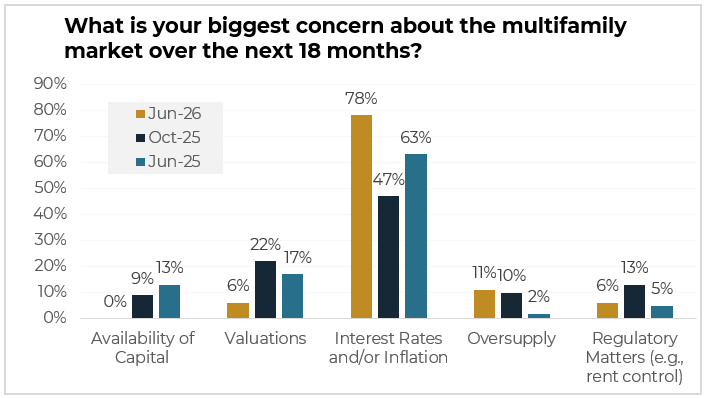
Our audience polling provided a stark reminder of how much sentiment has changed over the course of the past year. The responses to our survey question about interest rates show that they were much less worried in October 2025 than they had been a year ago in June 2025. Now, after three months of war-fueled uncertainty, they have reversed course again, with almost four out of five poll-takers citing interest rates and/or inflation as their biggest concern.
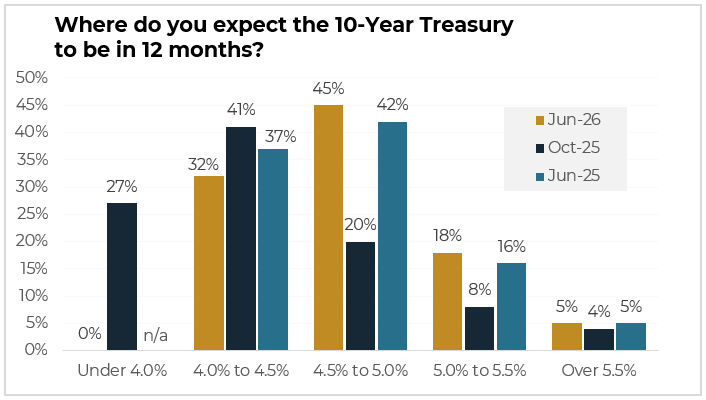
Similarly, they have become much less optimistic about prospects for 10-year Treasury yields over the next 12 months. In past polls, a third or more believed that interest rates would range between 4.0% and 4.5%, with a substantial number — 27% — asserting just eight months ago they would fall below 4.0%. This time, such sentiment was nowhere to be seen — and almost half the respondents maintained they would fall between 4.5% and 5.0%. If anything, the responses show market sentiment has regressed to where it was a year ago. Chris concurred. “I think last fall’s respondents showed a little bit too much optimism,” he said. “I’ve been saying higher for longer for quite a while.”
In these circumstances, it is not surprising to see the vast majority of participants stepping to the sidelines, at least temporarily. When asked to describe their net position over the next 12 months, 77% said they would be holding. The increase from October is almost entirely due to those who formerly described themselves as net buyers.
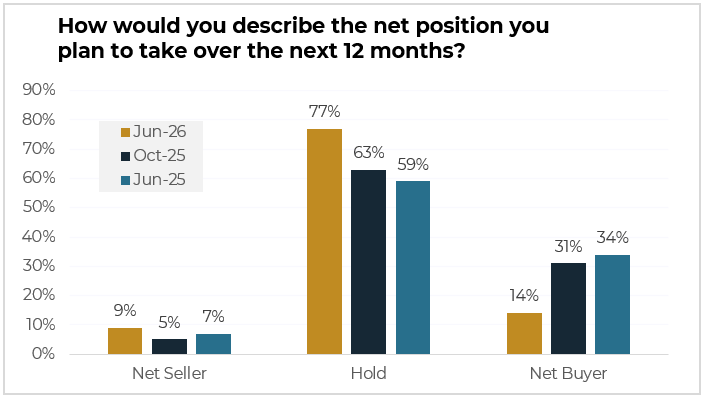
But the poll did reveal some good news. No one is concerned about the availability of capital, which aligns with our experience at Lument. And no one foresees an interest-rate apocalypse. Just 5% see rates going over 5.5%, a figure that has been essentially the same for the past year. Finally, although the absolute change is small, the number of those planning to be net sellers has increased by 80% while the share worried about valuations has dropped by a similar amount, suggesting that the bid-ask spread is showing signs of closing.
Taking Steps to Mitigate Inflation
Inflation is top of mind at Granite Towers. “We believe our expenses are going to increase more than the historical norm this year,” Mike said. “That’s something we’re starting to account for in our underwriting and budgeting, both for current properties and future acquisitions.” Mike is looking for inflation to appear in line items like payroll, utilities, and the general cost of goods.
Among other efforts, Granite Towers has been working to offset the effects of higher prices on its net operating income (NOI) by bringing in a team of experts to refine its preventive maintenance program, making sure its properties are in good repair and avoiding expensive emergencies. The company has also begun deploying AI tools for leasing, increasing retention rates, and collections.
AI has had an equal impact on the corporate side, according to Mike, improving his team’s efficiency by between 50% and 100% over the past two years. In addition, it has enabled staff to bring routine legal and accounting work in-house, reducing expenses. “AI has been a huge, huge plus for us,” he said.
Inflation has also been an important driver in Granite Towers’ decision to recalibrate its value-add strategy, moving up its target assets to B+ to A-minus properties. “Tenants in these communities tend to really care about where they live, and they also maintain a stronger credit profile, which translates into lower turnover costs and higher collections,” he said. Granite Towers is now concentrating on submarkets with high median incomes, which provides leeway for revenue growth.
Chris, too, is worried about inflation, but takes a contrarian position. He doesn’t think the surge in gasoline and diesel prices is its root cause. He argued that coming into the crisis, the United States had the cheapest inflation-adjusted gas prices in decades and that gasoline consumption represented just 1.7% of total consumer spending. The 30% to 40% price increase for gasoline pushed up its portion of consumer spending by only half a percentage point, Chris said — and, with gasoline taken out of the equation, consumer spending grew between February and April. He pointed to the Federal Reserve’s quantitative easing and larger than expected deficit spending as reasons why baseline inflation is as high as it is.
Seeing Opportunity When Others Take a Pause
Although some investors are stepping away from the market, inflation and uncertainty are not dampening Granite Towers’ enthusiasm for multifamily or its acquisition plans. “Although I don’t think we will be involved in a large number of transactions over the next 12 months, we’re looking to be net buyers,” Mike said. “We’re bullish about where the multifamily market is right now and where it’s going to go over the next few years.”
Granite Towers is seeing pricing decline 20% to 40% in some of its markets, an increasing number of distressed assets coming up for sale, and more listings in its target 100-to-500-unit range. Citing our poll results showing that the vast majority of investors are standing on the sidelines, Mike points out that there will be much less competition. “If you can get the capital together, this is a pretty incredible time to pick up some good buys,” he concluded.
To keep his options open and reduce expenses, Mike targets five-to-seven year fixed-rate agency debt, usually in the 65% to 70% loan-to-value (LTV) range, with three-to-five years of interest-only payments. “We feel that interest rates are likely to come down over the next few years, but we would like the term on our loans to be long enough that we can weather any kind of storm that comes up,” he said.
A Safe Haven in Turbulent Times
A less immediate concern for Chris than the Iran war — but one with greater long-term significance — is the amount of federal borrowing underway in the face of a record national debt. When the One Big Beautiful Bill Act was passed, legislators counted on $300 billion a year in tariff revenues, which are now off the table. Currently, the debt-to-GDP ratio is over 100%, the highest it has ever been. “This is just not a sustainable situation,” Chris said. “The scary thing for me is how exposed the federal government is to a rise in interest rates. And while we are not there yet, there has to be a reckoning sometime in the future. We are going to face higher taxes or sharply reduced federal spending or both.”
Chris’s view is that investing in the multifamily market is one of the best ways to mitigate the effects of this readjustment, whenever it occurs. “The fact of the matter is that there has not been enough housing built in this nation over the past 15 years to meet overall demand — and while demand will reflect declining immigration and population growth, supply constraints will continue to support the market far into the foreseeable future.”