
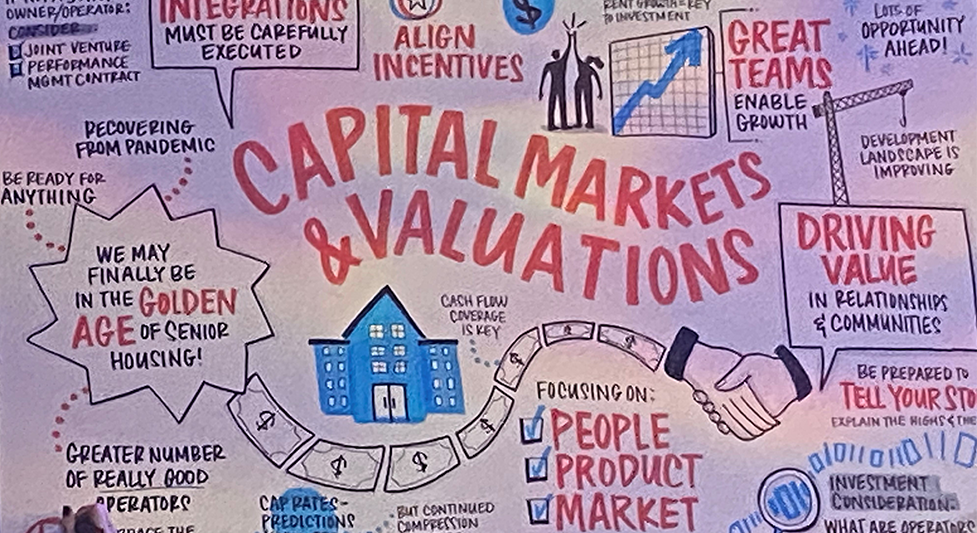
According to panelists at the Capital Markets and Valuations session at NIC Spring 2026, seniors housing deal pipelines are as robust as they have been in several years. Deal flow is “like drinking out of a firehouse,” as Rick Matros, president, CEO, and chairman of Sabra Healthcare REIT, put it.
Sabra’s “massive” pipeline is 90% seniors housing (independent and assisted living), he noted. That is not because the skilled nursing industry is not attractive to investors, it is, but more a reflection of where the opportunities are (seniors housing). The few appealing skilled deals that do come to market often get “gobbled up” by private equity quickly.
Kathy Ryser, senior director of senior housing underwriting and credit at Freddie Mac, shared the optimism about seniors housing, noting her team “loves the seniors space and is very supportive.”
Booming loan production backs it up. After closing $2.6 billion in 2025, Freddie expects to hit $4 billion this year. The agency has provided just under $10 billion in liquidity over the past five years, Ryser noted, helping the industry weather the storm of COVID and rising interest rates. The industry’s resilience coupled with the demographic trends make seniors housing immensely appealing. As such, Freddie Mac is “guns blazing and all about seniors housing” as 2026 unfolds.
New Money
That appeal has not gone unnoticed as there has been a lot of new capital attracted to the space as of late. “Tourists” (i.e. transitory investors) have been coming and going for decades, but the steady demographics may make this time different. That said, operational experience matters too. If there is another operational disturbance of some kind, capital new to the industry won’t have the battle-tested resume of those who endured a pandemic and an interest rate spike. Strong teams with long history in the industry have a lot of value. “Great teams scale,” as one panelist put it.
In terms of how new investors are viewed by an agency like Freddie Mac, there is more focus on risk with credit underwriting, especially in a regulatory environment like seniors. New investors may see stricter loan terms, shorter interest only, and heightened risk due diligence.
New Development
The industry continues to wait for the new construction spigots to turn on, although the moment does not appear to be now. Although there are some new development transactions in certain markets, it’s not indicative of a trend, instead market specific. Panelists predict it will be at least five years before any material development, maybe longer. The little bit of new development that is working is typically in less expensive markets where you can underwrite rents to a level that makes the deal work.
Most transactions are still acquisitions, as one panelist noted you can acquire a 10-year-old property at $250,000 per unit, while new development is more like $600,000 to $1 million per unit. The difference is so substantial it’s hard to envision significant change on this front. On the other hand, the demand is there, leading to an undertone of confidence that eventually this logjam will break.
Valuation Trends
With the 10-year Treasury bouncing around, is there concern about cap rate compression increasing? Perhaps slightly, but nothing too worrisome, as there has been somewhat modest compression of approximately 50 basis points over the past year. It is important to note, however, cap rates vary significantly between primary and secondary markets.
Relative to other elements of commercial real estate, seniors housing enjoys a healthy debt per unit margin, which helps valuations. The most important thing is predictability, panelists agreed, as a thoughtful investment strategy reaps benefits for all. If the macro distractions can dissipate, or at least decrease, the industry can really thrive.
Tips for Operators
It is important for operators to showcase their community and culture—do not assume investors know anything about your story. From quality assurance programs to employee incentives, detail all the elements that make a community distinct, resident-centered, and competitive in its market. All the little things can add up to make a real difference during underwriting. They also help build a reputation for an operator which goes a long way in the eyes of Fannie Mae, Freddie Mac, and HUD, as well as other organizations.
Incentives are an increasingly essential element of successful operations. Staff bonuses are tied to such operational metrics as the five-star rating. The idea is to incentivize employees like owners, which has a ripple effect of benefits including happier residents and staff.
Giving employees the tools to bet on themselves with incentives affords them a chance to participate in the upside of the company. Ultimately, every aspect should see more value, which has real cumulative benefit for communities throughout the industry.
Ample Upside
The arrival of the silver tsunami left panelists feeling decidedly optimistic, despite any macro or labor headwinds seniors housing faces. Industry veteran Matros noted he’s been “literally through every cycle. I just don’t see it (downside). I think the opportunity is all in front of us. I don’t see any downside. And we deserve it. We should just enjoy it and not lose any sleep over it.”