
For multifamily investors, the war in the Middle East presents a paradox. On the one hand, the conflict does not bode well for the economy. Feedstocks that flow through the Strait of Hormuz are essential not only for transportation and heating but also for sectors as varied as specialty chemicals, agriculture, and semiconductors. The longer the conflict goes on, the greater the potential for igniting sustained inflation and slowing growth.
On the other hand, the multifamily industry, with its strong fundamentals, seems well positioned to weather these headwinds. True, already cash‑strapped consumers may not be able to absorb significant rent increases. Material costs may also rise. However, increases in the 10‑year Treasury have been muted by the perception that the United States — despite abrupt policy changes and vacillating tariffs — remains a safe haven. The high cost of homeownership and the persistent shortage of housing means that rentals are more attractive than ever.
The bottom line: Although tailwinds still outweigh headwinds, the optimistic predictions for 2026 and 2027 expressed during the winter conference season — that all lenders will re-enter the market, spreads will tighten, and origination volume will spike — are likely to be put off until the consequences of the conflict play out. By staying disciplined, flexible, and conservative, investors will be able to navigate through this period.
The Underlying Fundamentals Transcend Geopolitics
Although overshadowed by events in the Middle East, the forces driving multifamily demand at the beginning of the year will continue to underpin the market. There are a number of substantial structural supports sustaining the asset class, foremost among them, the discount for renting versus buying. Although the difference between the cost of home ownership and renting varies from market to market, generally speaking the gap has become wider over the past 25 years. According to S&P Case Shiller, U.S. national home prices are up 330% during this period while rents have risen 250%.
This trend has kept turnover low and supported apartment occupancy. According to Green Street, annualized unit turnover has dropped steadily since 2007, and move-out-to-buy rates are at their lowest point in the past two decades. Stickiness is particularly pronounced in both Coastal and Sunbelt markets, where move-out-to-buy rates are roughly 460 and 600 respective bps below long-term averages. Although the wealth transfer from Baby Boomers over the next decade will support homeownership for some Millennials, additional obstacles to buying a home – including softer labor markets, elevated mortgage rates, and the lock-in effect of low mortgage rates on existing homeowners – persist.
Other trends bolstering the multifamily market include the thinning of new supply. Higher capital costs have slowed development, setting up a healthier supply-demand balance in most markets as deliveries taper into late 2026. In addition, we are seeing some additional household formation as young adults move from home and those with roommates look for single apartments.
Despite this generally optimistic outlook, there are some headwinds. Muted job growth and lower net immigration will weigh on demand over the next few years. Slower wage growth, depleted savings, and higher debt service costs will also squeeze disposable income and likely exert a cap on rent growth.
Combine tailwinds and headwinds, and the resulting picture is of muted but positive revenue growth in the next few years once the effects of the Middle East incursion are in the rearview mirror. Of course, performance will vary from market to market.
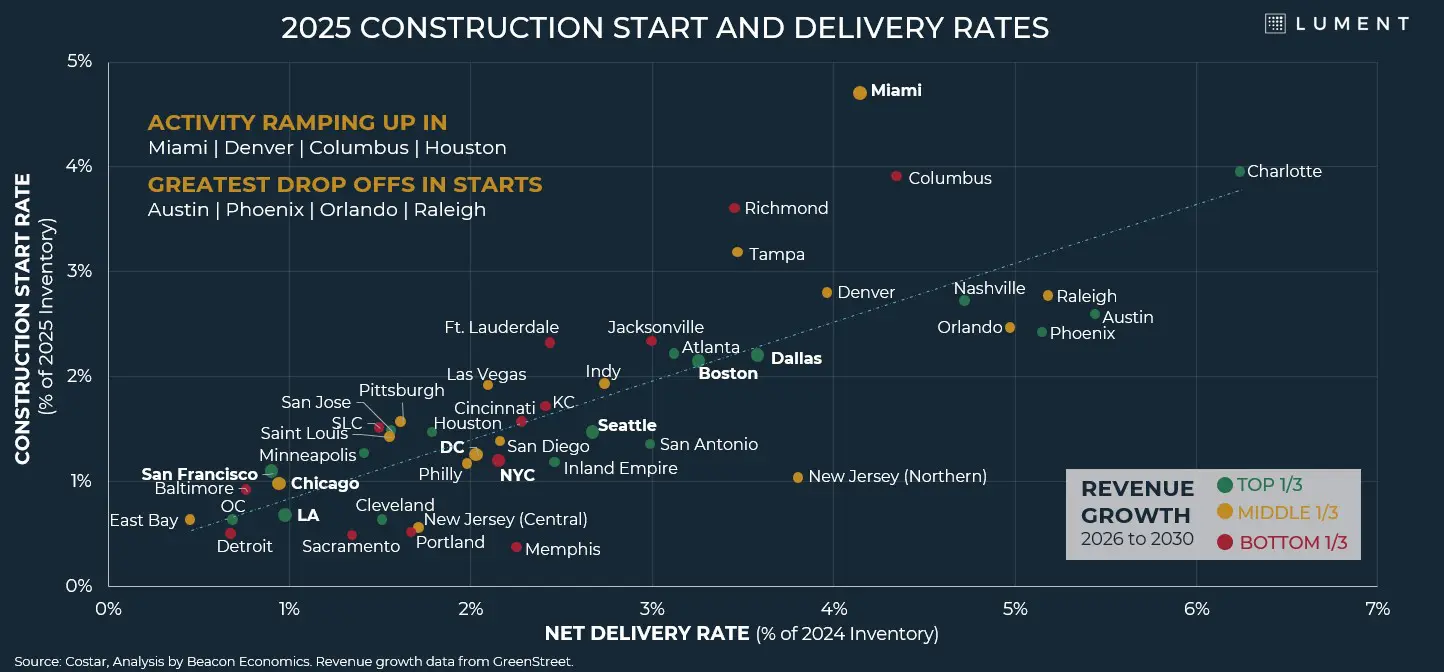
Some supply-heavy Sunbelt metros like Raleigh-Durham and Orlando are still working through supply compared to others like Dallas. Along the coasts, tech-centric metros like Seattle and the Bay Area are expected to see above-average growth, while metros like Boston and Washington exposed to policy-driven constraints like rent control or labor headwinds may underperform.
Transaction and Lending Growth May Decouple
The immediate prospects for transaction growth are less clear today than they were just a few months ago. In 2025, apartment transaction volume reached $130 billion, up 13% from $115 billion the previous year — and it surpassed $40 billion in Q4, the highest quarterly volume since Q3 2022. In the short-term, deals already in the pipeline should extend the trajectory established in 2025, but if oil doesn’t start to flow through the Strait of Hormuz in the next few months, transaction volume, which had been climbing steadily, may stall.
A pause in transaction growth, however, may not affect lending volume because, war or no war, there is a substantial maturity wall that must be worked through. Thirteen percent of mortgages backed by multifamily properties will mature in 2026 — and GSEs represent the fastest growing segment of that debt over the next few years. According to the Mortgage Banking Association, there will be a 47% annual increase in maturing Agency debt from 2025 to 2029, a leap from $31 billion to $144 billion.
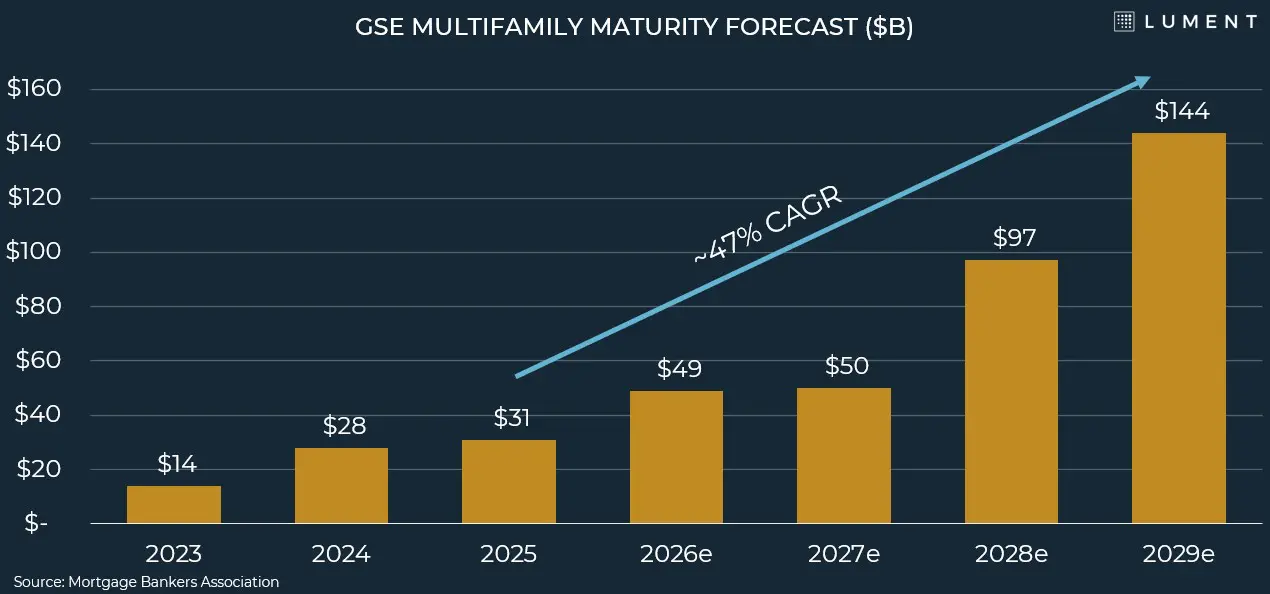
During the first half of the decade, many lenders have been “extending and pretending,” but there is a sense that they are running out of patience. This means that owners will either find creative ways to refinance — for instance, using preferred equity or recapitalizing — or they will be forced to sell.
The Multifamily Exception
The impact of the war on multifamily operating expenses and development costs is straightforward. Higher energy prices will be felt directly in elevated heating bills and indirectly in rising materials costs — and the ensuing inflation may bleed over into wages and services. Higher interest rates, in turn, may make it difficult for investors to lock in deals. The combination of higher rates, growing materials costs, and uncertainty is likely to mean that developers may put new construction on hold until they gain a clearer view of their prospects.
Much depends on how long the conflict goes on. If it is short-lived, energy prices and interest rates may fall relatively quickly to prewar levels, limiting lasting damage. A war that grinds on, producing substantial damage to Middle Eastern energy infrastructure while blocking the flow of oil, would likely result in significantly higher-for-longer interest rates — and put the Fed in the awkward position of having to choose between reining in inflation and pumping up a deflating economy.
But even in these circumstances, the multifamily market should prove a winning choice for investors. It has a proven history of outperforming the stock market or private credit in times of economic stress. Its ability to generate income even in bad times will be increasingly valuable if the war and its consequences linger.
This article originally ran in Multifamily Executive here.