
Employee stock ownership plans (ESOPs) continue to emerge as a creative financing structure, particularly for healthcare owners seeking to exit the business given its labor-intensive nature. There are over 6,600 ESOPs nationally, totaling over $2 trillion in wealth and over $166 billion in annual plan distributions, according to Department of Labor data[1].
Despite ESOPs’ transformative benefits for both owners and employees, the structure has been utilized sparingly in the healthcare sector. Reader note: Lument Securities has closed over 70% of existing ESOPs in the sector(Lument ESOP Credentials)[2]. As owners consider an ESOP for a strategic exit, it is important to note that not all ESOPs are created equal.
The merits of an actual ESOP are not under debate – a fair market valuation, path to liquidity, estate planning and meaningful tax advantages (a 100% ESOP is federally tax-exempt[3]*), and enhanced recruitment and retention tools. These benefits are particularly compelling for an operating company (OpCo) and/or management company (MgmtCo), whether or not the real estate (PropCo) has already been monetized.
Given the attractive tax incentives afforded to an ESOP and the compelling long-term benefits, it is no surprise that private equity (PE) groups have shown a renewed interest in the sector. For example, one PE group recently established ESOP vehicles to pursue future acquisitions– Ownership Works (established in 2022) and Expanding ESOPs (established in 2024). However, the “Broad Based Employee Ownership” structure that is pushed by PE is more akin to a short-term equity plan (STEP) –a critical distinction owners need to consideras the touted benefits may not be fully realized, such as denying sellers the opportunity to defer capital gains, among other transactional benefits.
Generally speaking, PE groups have established an employee ownership program by setting aside up to 10% (~3-6%, on average)[4] of the company’s fully diluted equity at close. As opposed to an ESOP that establishes an evergreen company where employees gradually benefit over an extended period, under this new structure, employees only share in the upside via a future liquidation event alongside all investors. The plan’s benefit is limited to the level of payroll tax deductions taken over the hold period. The ESOP Association (TEA) went as far as to deem the proposal a redistributive tax policy.4
Reader note: Taxes are a more complex topic, particularly as it relates to an ESOP transaction. If a PE forms an ESOP, they could eliminate tax benefits to a seller and limit the corporation’s own tax benefit depending on percentage sold to an ESOP. These topics warrant a deeper dive with a tax advisor given their significant impact.
Given ESOPs’ popularity, PE groups are now proposing that ESOPs be redefined to accommodate this new structure. If passed, the STEP structure would benefit from the same tax advantages as a true ESOP despite the fundamental differences in materialized benefits.
As TEA notes, “ultimately, these new and exclusive arrangements are specifically designed to be terminal. Meaning, the goal is to sell and terminate the plan, not create a multi-generational business owned by employees that can grow wealth.”[5] Ownership Works’ imputed benefit translates to under 1% of shared equity with employees[6] – underperforming the level of benefit by existing ESOPs.
To further illustrate the divergence between structures, TEA highlighted key variances4:
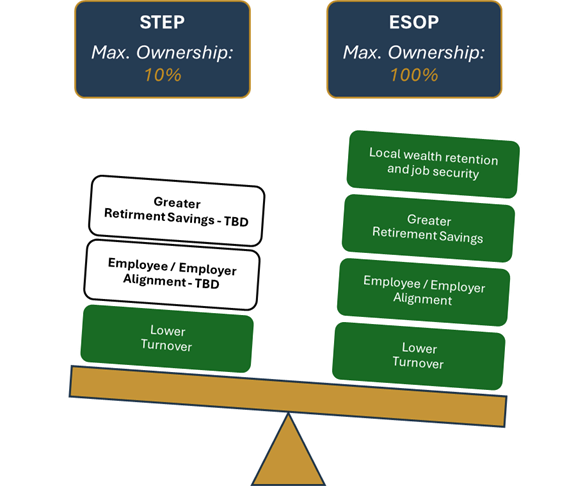
TEA’s messaging is clear: the newly proposed models “do not create, protect or benefit employee owners.”[7] If legacy preservation and transformative ownership culture are key objectives, pursuing this new PE structure would not substantiate these goals.
Employee Recruitment and Retention Advantages
An ESOP is a flexible exit strategy structured as a stock sale – effectively de-risking future liability. One of the powers of an ESOP is the ability to accommodate multi-generational succession strategies as the ESOP is indifferent to the amount of equity acquired (i.e., 1% or 100%). Ultimately, the evergreen company that can be established fundamentally transforms workforce culture, empowering employees to think and act like owners and enhancing the company’s long-term recruitment and retention tools.
It is worth noting, an ESOP is akin to a 401(k) plan with employees benefitting gradually over time through tenure and service. Ultimately, day-to-day corporate governance remains unchanged as employees become beneficiaries of a trust established for their benefit. Benefits span virtually all employees, from C-suite executive management to facility-level employees and can be broad based or at a management company level. An ESOP is highly customizable to a seller’s objectives.
Lument Securities has seen the power of an ESOP in action. For example, in a recent sale of an ESOP-owned company where Lument Securities served as exclusive financial advisor, a mid-level employee planned to retire following the sale. The benefits received were a “life changing event” in their words, increasing benefits five-fold as a result of the appreciation of share value.
These benefits provide meaningful recruitment and retention tools for providers in an ever-challenging labor environment. As a result of the ESOP, employees and management begin to think and act like owners. Studies suggest that employee engagement, motivation, and retention increase in ESOP companies as employees focus not only on their daily tasks, but also on the top and bottom lines of the business.[8]
Why Consider an ESOP?
In addition to the employee recruitment and retention tools discussed above, there are several reasons to consider an ESOP transaction in the current market.
Unlike a more traditional transaction, the ESOP structure provides more certainty of close (as it is a direct negotiation with the ESOP trustee on behalf of the employees), while still providing a fair market valuation. Further, the ESOP structure is flexible and customizable based on the objectives of the current owners. The structure can be a minority, majority, or full sale – the transaction can also occur in phases over time. This is particularly useful if shareholders have different objectives (such as some desiring liquidity and others desiring continued equity upside), as not all shareholders must sell.
In addition, there are corporate and capital gains tax advantages. S-corporations that are 100% owned by an ESOP are fully exempt from federal income tax. Further, sellers may elect a Section 1042 rollover allowing sellers to defer capital gains by reinvesting the principal proceeds in a qualified replacement property (i.e., stocks and bonds), which will receive a stepped-up basis and completely avoid capital gains tax if certain conditions are met. Philanthropic gifting can be structured with an ESOP as well.*
The ESOP remains the most viable OpCo and/or MgmtCo sale alternative given the shallow buyer and lending markets for OpCo / MgmtCo only transactions; but an ESOP can also be coordinated with a PropCo alternative, such as a sale-leaseback transaction with a REIT or investment firm or by including the PropCo in the transaction.
Legislation on the Horizon Enhances ESOP Structures*
ESOP structures were first established in 1956 and formalized under ERISA law in 1974. Since 1974, ESOP has benefitted from legislation that has expanded benefits over time. However, ESOP complexity is partially driven by regulatory ambiguity. Encouragingly, Congress continues to recognize the merits and has introduced new bills that, if passed, would continue to enhance and expand benefits nationally.
- The ERISA Litigation Reform Act (HR 6084) was discussed in a December 2025 House Education & Workforce Committee’s Health, Education, Labor, and Pensions (HELP) Subcommittee hearing. The legislation as introduced will reduce frivolous class action lawsuits on ESOPs as it would include three provisions: (1) change the standard of proof for adequate consideration which shifts burden of proof to the plaintiffs; (2) plaintiffs would be required to prove the service provider fees were not reasonable; and (3) discovery would not occur until the court has decided a claim can move forward.[9] The bill, if passed, would restore balance to the legal framework around ESOPs.
- American Ownership and Resilience Act (AORA), introduced in May 2025, seeks to enhance access to capital for ESOP transactions to “level the playing field” by extending $5 billion of annual federal loan guarantee credits to both existing and newly created investment groups specializing in ESOP deals. The investment groups would apply via the U.S. Department of Commerce to receive an “ownership investment company” license. Qualified partners could then use $500 million of low-cost debentures issued by the Commerce Department (matched dollar-for-dollar) over a 10-year period.[10] The sector is eagerly awaiting final approval for the bill to be adopted by the House and passed to the Senate.
In addition, two new pro-ESOP bills were introduced and passed by the Senate in 2025: (1) Retire Through Ownership Act and (2) Employee Ownership Representation Act. Both were received by the House in October 2025 and are pending further action. These two bills seek to provide clarity around adequate consideration and establish a new advisory council with two representatives from employee-owned organizations.
Taken in aggregate, the new legislation, if enacted into law, would enhance the operating environment of ESOPs and reduce regulatory uncertainty for future transactions. Coupled with enhanced access to credit, these proposals could further open the gates to healthcare ESOPs.
Conclusion
In summary, ESOPs are highly complex structures that drive meaningful “win-win-win” benefits for all stakeholders (i.e., sellers, the company, and employees). However, given the increasing interest, divergent ESOP structures are surfacing, and owners need to be aware that not all ESOPs are created equal. A proper understanding of each structure ensures that seller goals and objectives can be achieved at close. Sellers should be wary of new structures that are marketed as an ESOP but cannot ultimately deliver the same benefits. As such, detailed and structured due diligence at the onset of any process will ensure sellers properly weigh the risks and rewards of each structure.
Lument Securities is adept at navigating dual-track structures, creating competitive positioning between cross-over approaches to optimize results. If you are considering an ESOP as an exit strategy, contact Laca Wong-Hammond today to perform a customized strategic options assessment.
*The information provided is for general informational and educational purposes only and does not constitute tax, legal, or accounting advice. Lument does not provide tax or legal advice. You should consult your own tax, legal, and accounting advisors before engaging in any transaction.
[1] NCEO, Employee Ownership by the Numbers, 2026.
[2] Calculations by author from researching Form 5500: https://www.efast.dol.gov/5500Search/, Business Code: 623000 (Nursing & Residential Care Facilities). There are eight existing ESOPs nationally involving seniors housing and care communities. Lument Securities advised on six of those transactions.
[3] To substantiate 100% federally tax-exempt status, owners must sell 100% of the equity to the ESOP and the company must be incorporated as an S-Corp.*
[4] The ESOP Association, “The Dangerous New World of Private Equity in ESOPs”, Nov. 2025
[5] The ESOP Association, “The Dangerous New World of Private Equity in ESOPs”, Nov. 2025
[6] The ESOP Association, “The Dangerous New World of Private Equity in ESOPs”, Nov. 2025
[7] The ESOP Association, “The Dangerous New World of Private Equity in ESOPs”, Nov. 2025
[8] The ESOP Association, “The Dangerous New World of Private Equity in ESOPs”, Nov. 2025
[9]H.R. 6084: ERISA Litigation Reform Act https://www.govtrack.us/congress/bills/119/hr6084
[10] H.R. 3248: American Ownership and Resilience Act https://www.govtrack.us/congress/bills/119/hr3248