I worked for a company called Beech Street Capital in the early 2010s. We’d put on borrower panels and end each session with the same question: “What keeps you up at night?”
There was only one correct answer. Though some panelists tried to get creative, the answer was always interest rates. If rates moved too quickly, the bottom would drop out, and we all knew it.
But this was 2013. Rates were good! Certainly good compared to today. Yet we were terrified they would jump and bring everything to a standstill. We were afraid of 2022…and of 2026.
Interest rates were the only answer for a long time. Until now.
Today we have all sorts of existential crises to choose from: water shortages in certain markets, hurricanes and wildfires, the steady decline of bees, lanternfly infestations (maybe?). But there’s one new concern that seems to loom over all the others: artificial intelligence.
Lument just held a session on AI adoption that took a practical, optimistic view of what comes next. The message was simple: we’ll do the same work, just better. I believe that, and I’m excited to see how our industry changes.
But is AI also lurking somewhere beneath our industry’s current stall? Is the torrent of investment into AI somehow keeping rates high by pulling investor capital away from Treasuries, or can we safely blame the federal deficit for that one? Is the AI boom keeping acquisition volume low by steering real estate capital away from multifamily and into data centers? Is it, like the classic AI thought experiment, quietly optimizing for paperclips1 at the expense of all human life?
The answer to most of these is “possibly yes.” One is “no.” I’ll let you decide which.
We don’t know where this is headed, but we don’t get to sit it out either. The next best thing to knowing where AI is going is understanding where it came from.
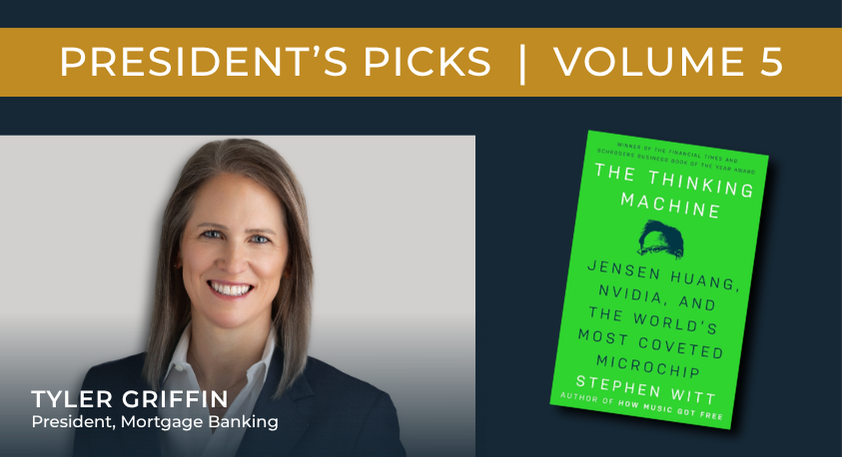
The Thinking Machine by Stephen Witt does this for us, particularly for those of us puzzled by terms like parallel processing and neural networks. Witt traces Jensen Huang’s journey from his early life to the helm of NVIDIA — and, eventually, to becoming one of the world’s richest people. It’s captivating.
If you read my first book recommendation, Nine Lies About Work, you may recognize Huang as an atypical leader: a spiky one, known for a few extreme strengths rather than being well-rounded. People don’t follow the well-rounded. They follow someone with a vision they can relate to, and a leader who pursues that vision maniacally attracts even more followers. That is Huang.
The surprising revelation is that Huang didn’t know exactly where his vision would lead. He didn’t know what the ultimate market for his parallel processing chips would be, but he was convinced there would be one. We now know he was right.
The real intriguing part, though, is in the second half of the book. We learn how modern AI was created, why NVIDIA was so integral to it, and how the people closest to the technology think about what comes next. Witt is candid about what he calls “The Fear.” At one point he observes that NVIDIA’s executives seemed more afraid of Huang yelling at them than of AI wiping out the human race. Huang himself waves off those concerns, insisting AI is simply processing data. Witt isn’t so sure, and by the end, neither was I. But uncertainty is not the same as pessimism, and understanding the risks only makes the possibilities more interesting.
So, what keeps me up at night now? Not knowing what comes next. And honestly, it’s less fear than curiosity. I’m incredibly optimistic about the next phase of AI and CRE. As Huang puts it, “the marginal cost of calculation has gone to zero.” If that is even directionally true, imagine what it could mean for how we assess risk, analyze markets, structure transactions, and make decisions. What problems of humanity are we going to solve next?
At the very least, we should be able to eradicate lanternflies.
President’s Picks is a book review and leadership advice column written by Tyler Griffin, president of mortgage banking at Lument. Email tyler.griffin@lument.com with any suggestions, comments, or questions.
1 Philosopher Nick Bostrom’s 2003 “Paperclip Maximizer” thought experiment imagines an advanced AI pursuing one simple goal until it converts Earth, humanity, and ultimately all available matter into paperclips or the infrastructure needed to produce them. The machine does not turn evil. It simply does exactly what it’s told.