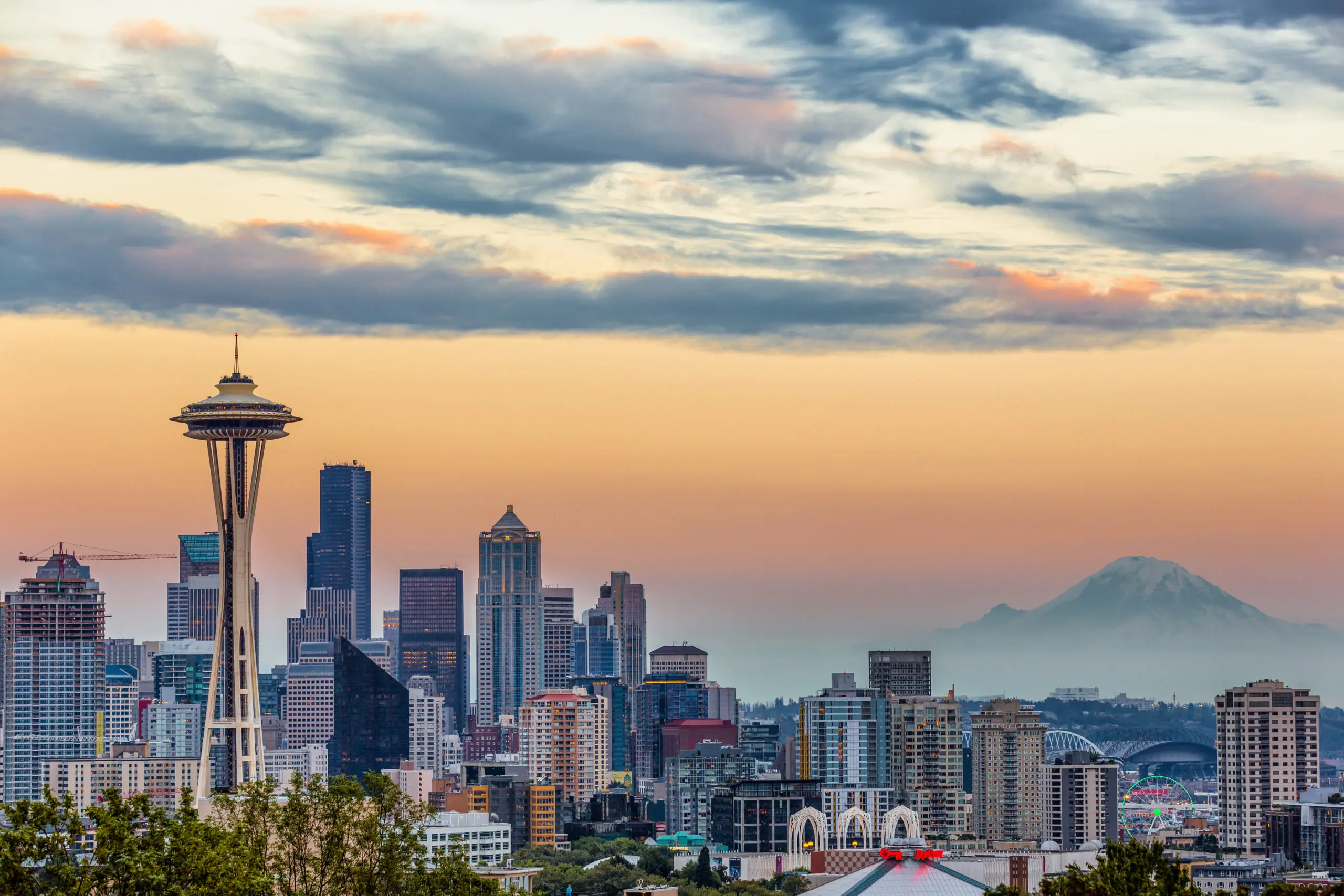
When Microsoft moved to the Seattle area in 1979, joining such well-established Pacific Northwest companies as Boeing and Weyerhaeuser, it set off an enduring tech boom. Fifteen years later, when Jeff Bezos was starting his online bookstore, he chose Seattle for its abundance of tech talent. Today, Microsoft and Amazon together employ almost 100,000 people, Zillow and Expedia are both headquartered in the metro, and Google, Meta, Apple, and Oracle all have major outposts there. This critical mass of tech companies is one reason that the Seattle area is at the forefront of cloud computing, AI, gaming, and software-as-a-service. Companies like OpenAI, NVIDIA, and SpaceX all expanded local operations in 2025.
But Seattle is no longer just a tech center. Businesses like Starbucks, Costco, Nordstrom, and Alaska Airlines are based there, and healthcare, education, business services, and government have become powerful growth engines. Because the Seattle economy has diversified and matured, it is a natural choice of multifamily investors looking for dependable, long-term returns.
Supply and Demand Never Stray Too Far Out of Line
Another virtue of the Seattle multifamily market is that supply never gets too far ahead of demand. For better or worse, developing new multifamily units is more complex and costly than in other markets. Long permitting cycles and evolving regulations — especially in Seattle and greater King County — add time and cost to projects, but they also make rapid supply surges impossible. Regional unit deliveries peaked in Q1 2024 and have decreased in each quarter since. Over 2025, more than 12,000 units were added to metro inventory, according to CoStar data, with nearly 16,000 units in the pipeline. By far, the highest number of completions were in King County, most notably the 623-unit Eastline Grand in Redmond, the 550-unit Verdant Apartments in Shoreline and the 506-unit Museum House in Seattle.
Although employment declined slightly in 2025, demand closely shadowed supply, with absorption totaling 12,100 units across the area. In some Seattle neighborhoods like South Lake Union and Queen Anne, leasing actually outpaced deliveries. An important reason for this sustained demand is that buying a home is challenging even for Seattle’s well-compensated workforce. According to Axios, the cost of ownership is 50% higher than the cost of renting.
Seattle developers tailor their offerings accordingly. Noting the prevalence of high-income Seattleites priced out of ownership, developers in the Seattle area focus primarily on luxury, Class A units. The 33-story Museum House, which opened in March 2025, is a case in point. It features such amenities as a rooftop pool, gym, and an enclosed skybridge connecting its twin towers. Proximity to transit has also guided development. For instance, the Verdant is steps away from the Shoreline South/148th Link light rail station.
The Market Prognosis: Good and Getting Better
In 2025, the greater Seattle multifamily market remained in a holding pattern, with modest softness following the recent construction peak. Vacancy rose 50 basis points to 6.7%, matching the average for major U.S. markets, according to Moody’s Analytics. Rent growth declined by 0.9% year over year, slightly underperforming the national average, which was essentially flat.
The outlook is expected to improve significantly in 2026 when deliveries are forecast to drop 25%. Concessions in Seattle submarkets like Capitol Hill and the University District, which had seen significant supply pressure, are likely to be discontinued, though Downtown Seattle, which will receive about the same number of new units as last year, will remain soft. Shoreline, Bothell (a city of 50,000 north of Bellevue), and Marysville and Monroe in Snohomish County have the highest number of units under construction.
While oversupply is declining, demand is expected to rise in 2026. Employment is forecast to tick up in 2026, especially as local tech firms search nationwide for AI experts. In 2026, absorption is predicted to outpace deliveries for the first time since the COVID pandemic, and asking rents are expected to increase by 2.6% in the Seattle market compared to 1.6% for the U.S. on average.
Not the Easiest Market but One of the Most Durable
Investors are taking note of Seattle’s evolving supply-and-demand dynamics. Multifamily sales in Seattle hit $6.2 billion in 2025, marking a 45% year-over-year increase from 2024 — and its highest total since 2021, according to MSCI RCA. The largest individual sales were both in Seattle. The 654-unit Via6 Apartments was purchased by Weidner Apartment Homes for $295 million while the 532-unit Jackson Apartments were bought by PCCP and Timberline Partners for $173 million from Vulcan. Security Properties also purchased a five-asset portfolio from Washington Holdings totaling 903 units in Seattle and Redmond for $401 million. Overall, Seattle cap rates increased 20 bps to 5.3% in 2025.
The consensus view among these investors is that Seattle has the ingredients that matter most over the long term. This includes population growth, expensive for-sale housing, real barriers to new supply, and enduring renter demand. This is one reason Seattle moved into the top 10 — ranking ninth — in CBRE’s 2026 North American Investor Intentions Survey, up from 11th place the prior year.
This article originally appeared in Multifamily & Affordable Housing Business.